Fruit Juice at Breakfast: a Habit or a Real Choice?

Breakfast, a moment of accuracy
Breakfast is often presented as a functional ritual.
A quick moment, sometimes automatic, rarely questioned in its quality.
Yet, it is the first taste contact of the day. The one that sets the tone, awakens the senses, and prepares the palate.
In this context, Fruit Juice deserves to be considered with more nuance: depending on the Fruit, its maturity, texture, and balance, it can accompany this moment accurately... or conversely, disrupt it.
At Alain Milliat, the answer is neither dogmatic nor binary: it is based on a fine reading of the Fruit — its nature, texture, tension, and aromatic persistence.
Fruit Juice in the morning: a matter of quality, more than principle
Saying that Fruit Juice is "good" or "bad" at breakfast makes little sense without considering what it actually contains.
A juice made from concentrate, standardized, enriched with added sugars or flavors, does not have the same reading as a 100% pure Fruit Juice, made from varieties selected for their maturity and aromatic profile.
A well-crafted tasting Juice brings:
A natural freshness,
An aromatic liveliness,
A clear and faithful expression of the Fruit
It then fully finds its place at breakfast, as a first burst of freshness that awakens the palate, provided it fits into a balanced moment, and does not replace the meal.

Juice or Nectar: which to prefer at breakfast?
Juices: Freshness and aromatic tension
Fruit Juices express the Fruit in its most direct form. Their texture is fluid, sometimes slightly pulpy, and their aromatic profile is often straightforward and bright.
At breakfast, they are particularly suitable for those who seek:
A crisp freshness,
A controlled acidity,
An accurate reading of the Fruit.
Alain Milliat Suggestions:
- Late Harvest Orange Juice from Sicily Bright and fresh, it reveals the balanced freshness and natural tension of an Orange harvested at late maturity.
- Cox's Apple Juice - Straight and delicately tangy, it expresses the liveliness and aromatic finesse of a Cox's apple.
- Pineapple Juice - Pure and vibrant, it conveys the juicy freshness and controlled sweetness of a fruit picked at full maturity.
- Pink Grapefruit Juice - Bright and structured, it offers an elegant bitterness and a crisp freshness that define the identity of the fruit.
These juices naturally find their place in the morning, alone or accompanied by a simple breakfast.
Nectars: sweetness and enveloping
Nectars follow a different logic. Some fruits, fleshier or less juicy, require a different approach to reveal their identity. Nectar allows for the restitution of their density and indulgence.
Their texture is creamier, their mouthfeel rounder.
They are particularly suited for:
A slow tasting,
A moment of sweetness.
Alain Milliat Suggestions:
- Williams Pear Nectar - Velvety and bright, it reveals the delicate freshness and aromatic purity of a pear picked at maturity.
- Bergeron Apricot Nectar - Pulpy and structured, it expresses the sunny richness and naturally balanced sweetness of the Bergeron Apricot.
- Mango Nectar - Dense and silky, it conveys the exotic generosity of the fruit with subtle acidity in support.
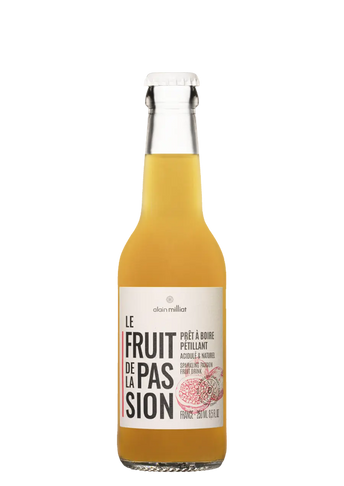
- Passion Fruit Nectar - Bright and dynamic, it offers a precise tangy tension that highlights the natural intensity of the fruit.
They can accompany a slice of bread, plain yogurt, or simply stand on their own.

How to integrate fruit juice into a balanced breakfast?
Fruit juice is not meant to replace a whole fruit nor to be the sole element of breakfast. It finds its place when it is:
- Consumed in measured quantities,
- Integrated into a larger set (bread, simple cereals, dairy products),
- Chosen for its intrinsic quality.
A glass of juice then becomes a tasting gesture, not a mechanical reflex.